Story Review | By Aby Mathew Vattamattam
Imagine reaching a moment in life when the usual measures of success no longer seem sufficient. The years have passed, responsibilities have changed, and achievements once considered important begin to appear less significant than the relationships, values, and experiences that shaped the journey. At such a moment, an important question emerges: what has life truly meant?
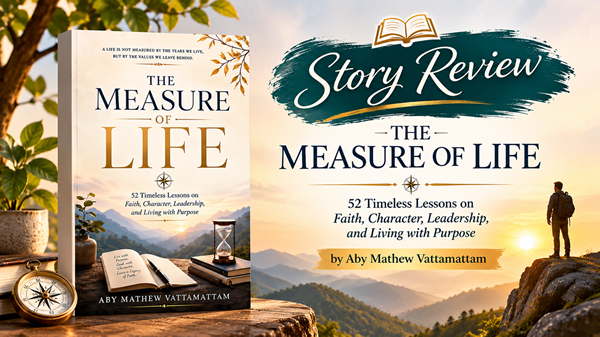
This question captures the philosophical essence of The Measure of Life: 52 Timeless Lessons on Faith, Character, Leadership, and Living with Purpose by Aby Mathew Vattamattam.
The book approaches life not simply as a sequence of events but as an ongoing process of understanding. Its central premise is that experiences acquire deeper significance when individuals reflect on the values and lessons behind them. This approach transforms the idea of personal development into something more substantial than the pursuit of ambition or external recognition.
The framework of 52 lessons reflects the belief that wisdom is not acquired all at once. It develops gradually as people encounter different circumstances and learn to distinguish temporary satisfaction from enduring meaning.
One of the strongest themes is the relationship between faith and uncertainty. Human beings naturally seek stability, but life frequently challenges even the most carefully constructed plans. Faith offers a perspective through which individuals may approach uncertainty with patience and hope rather than allowing fear to determine their decisions.
The second important theme is character. Throughout life, people encounter situations that test their principles. The choices they make in such moments often reveal more about their identity than their public achievements. By emphasising character, the book encourages readers to recognise that integrity requires consistency between beliefs and behaviour.
Leadership introduces the question of influence. A person does not need a prestigious designation to demonstrate leadership. Parents, educators, colleagues, friends, and community members all exercise influence through their words and actions. Responsible leadership therefore begins with personal example and the willingness to place values above convenience.
The theme of purpose connects these different ideas. A purposeful existence does not necessarily require extraordinary accomplishments. Sometimes it is expressed through fulfilling responsibilities sincerely, offering guidance to another person, or choosing compassion during challenging circumstances.
What makes the book’s central message emotionally relevant is its connection to the universal desire for significance. Most individuals want their lives to matter. They hope that their actions will contribute something valuable, even if that contribution is never publicly celebrated.
The author’s opening philosophy suggests that the importance of life is found not merely in what individuals experience but in how those experiences shape their understanding and relationships.
This distinction gives the work a contemplative quality. Instead of asking readers to measure themselves against other people’s accomplishments, it encourages them to examine their own values, responsibilities, and capacity to influence the world positively.
The title The Measure of Life thus becomes a question as much as a statement. It asks readers to consider whether their current priorities reflect the legacy they ultimately wish to leave.
For individuals navigating professional responsibilities, personal relationships, spiritual questions, or significant life transitions, the book’s themes offer opportunities for reflection.
Final Reflection: The Measure of Life presents a meaningful invitation to reconsider success, recognise the importance of character, and approach each stage of life with greater faith, responsibility, and purpose.