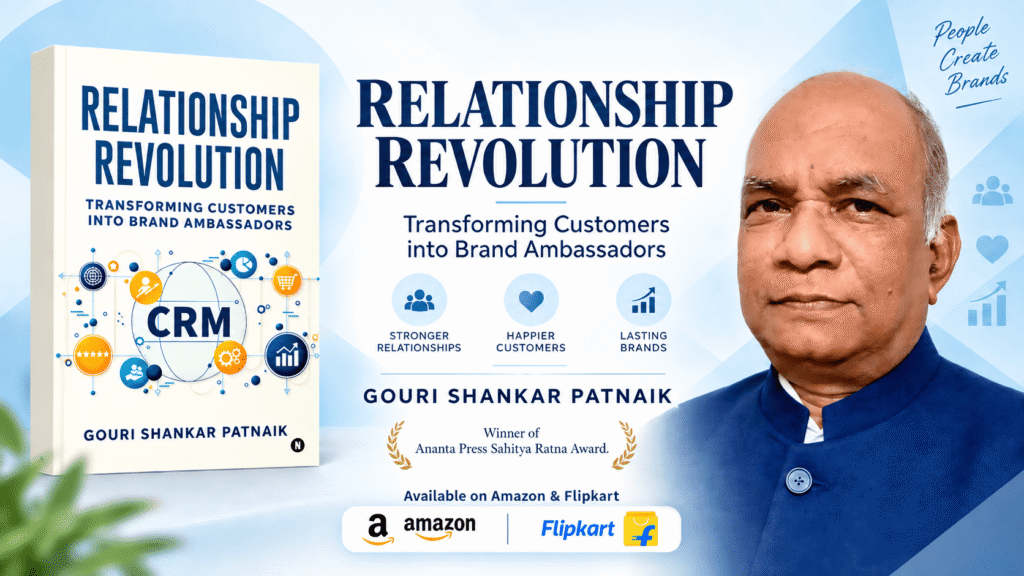
Organizations often say that they are customer centric, but customers frequently experience something different. Marketing may communicate one promise, sales may emphasize another, and service may have little visibility into either conversation. The customer moves through a single relationship, while the organization operates through separate departments. Relationship Revolution: Transforming Customers into Brand Ambassadors by Gouri Shankar Patnaik is valuable because it addresses this central contradiction of modern business. Through a comprehensive discussion of Customer Relationship Management, the book shows how marketing, sales, service, technology, and managerial decision-making can be aligned around the customer lifecycle.
The book’s most useful contribution is its integrated view. CRM is sometimes treated as a sales system because sales teams are often its most visible users. In other contexts, it is viewed as a marketing database or service platform. Patnaik presents a broader perspective in which CRM connects these functions. This matters because the quality of a relationship is cumulative. A customer does not separate an attractive campaign from a difficult purchase process or an excellent sales conversation from a disappointing service experience. Every interaction modifies the customer’s perception of the brand.
By linking CRM with the goal of turning customers into brand ambassadors, the book makes cross-functional alignment more than an internal efficiency issue. It becomes a brand-building requirement. Advocacy develops when the customer sees continuity in the relationship. The organization remembers commitments, understands context, responds appropriately, and delivers value consistently. When departments work with disconnected information or competing priorities, that continuity breaks. CRM provides a structure for reducing those gaps.
The book is broad enough to support readers with different professional interests. It examines concepts, benefits, technologies, and implementation strategies while keeping attention on managerial application. Students receive a comprehensive introduction to the subject, professionals can connect the ideas to day-to-day work, and industry leaders can consider CRM as part of business strategy. The ability to begin from any chapter increases the book’s practical value because readers can enter through the problem that matters most to them.
For marketers, the book reinforces the idea that customer acquisition is only the beginning of the relationship. Campaign performance can generate leads and awareness, but long-term brand value depends on what happens afterward. CRM helps marketing become more informed by customer history, preferences, behavior, and feedback. It also creates the possibility of more relevant communication. The goal is not simply to send more messages; it is to understand which interactions create value and which may damage trust.
For sales teams, CRM can create continuity and institutional memory. Sales relationships are often built through conversations, promises, follow-ups, proposals, and negotiations that unfold over time. When knowledge remains in individual inboxes or personal memory, the organization becomes vulnerable. A well-managed CRM approach preserves context and enables better coordination. Patnaik’s managerial emphasis is important here because the purpose is not to produce more administrative data but to help teams make better decisions and serve customers more effectively.
For service teams, the value of integrated customer information is equally clear. A service interaction should not begin as though the customer has no history with the company. Past purchases, previous issues, commitments, preferences, and relationship status may all affect how the organization should respond. Good CRM allows service employees to see enough context to provide continuity. This can reduce frustration, shorten resolution time, and make the customer feel recognized rather than processed.
The book’s focus on the customer lifecycle also encourages organizations to look beyond isolated metrics. Marketing may optimize click-through rates, sales may optimize conversions, and service may optimize case closure. These measures can be useful, but they do not automatically add up to a healthy customer relationship. A lifecycle perspective asks whether the organization is moving customers toward greater satisfaction, retention, loyalty, and advocacy. This broader outcome orientation is one of the book’s key strengths.
Gouri Shankar Patnaik’s professional background gives this integrated perspective additional credibility. With more than four decades of experience in the pulp and paper and manufacturing sector, including senior roles at JK Paper Ltd. and ITC Limited, he has worked in environments where organizational performance depends on coordination across functions. His expertise in quality governance, ESG and sustainability oversight, enterprise risk management, regulatory compliance, and quality systems reflects a career built around integration, control, and continuous improvement.
These experiences are particularly relevant to CRM implementation. Customer relationship strategies often fail not because the concept is weak, but because execution is fragmented. Teams may not agree on definitions, data may be incomplete, workflows may be inconsistent, ownership may be unclear, and senior leadership may view CRM as an IT project rather than a business transformation. Patnaik’s systems-oriented background makes the book attentive to the need for alignment between strategy and implementation.
Quality management offers a useful parallel. A quality system cannot succeed if inspection is the responsibility of one department while the rest of the organization ignores process discipline. In the same way, customer centricity cannot succeed if relationship management is delegated only to front-line teams. Product design, operations, finance, logistics, technology, leadership, and governance all influence the customer experience. The book’s cross-functional treatment encourages readers to see CRM as part of organizational design rather than as a narrow operational tool.
The discussion of technology is strongest when understood in this context. CRM platforms can create shared visibility, automate routine tasks, support analytics, and coordinate engagement, but their effectiveness depends on managerial clarity. Technology cannot decide what the company should promise, which customer needs matter most, or how employees should respond when standard processes do not fit the situation. Patnaik’s book keeps managerial judgment at the center. This helps the reader avoid the common assumption that digital transformation automatically produces relationship transformation.
Another notable quality is the book’s accessibility. CRM can become crowded with specialized terminology, platform-specific language, and technical detail. By focusing on strategic and managerial application, Patnaik makes the subject relevant to readers who may never configure a CRM system themselves. A leader, teacher, student, consultant, or functional manager can still benefit from understanding how customer knowledge should flow through an organization. This broad accessibility increases the book’s value as a learning resource.
The author’s involvement with industry and standards bodies also strengthens the practical orientation. His association with the Bureau of Indian Standards, TAPPI, IPPTA, and the Quality Council of India reflects engagement with professional communities concerned with standards, performance, and improvement. His work advising senior leadership and boards on ESG integration, Business Responsibility and Sustainability Reporting, environmental stewardship, compliance systems, audit readiness, and internal controls demonstrates experience in translating principles into governance mechanisms. That same discipline is needed when CRM moves from intention to execution.
The book also prompts a valuable discussion about organizational culture. Customer information can be shared, but employees still need the motivation and judgment to use it well. A company can install technology without becoming more empathetic, responsive, or accountable. Culture determines whether data is treated as a burden or as a source of insight, whether complaints are hidden or learned from, and whether departments collaborate or protect their own targets. Relationship Revolution is strongest when it encourages readers to think about these human dimensions alongside technology.
Brand advocacy provides an excellent lens through which to judge whether the culture is working. If customers repeatedly encounter inconsistency, they may remain buyers but are unlikely to become enthusiastic advocates. If they experience reliability, relevance, respect, and responsiveness, the possibility of advocacy increases. This makes brand ambassadors a useful symbol of the organization’s ability to coordinate many small actions over time.
For students, the book can clarify how traditional functional subjects connect. Marketing, sales management, service management, information systems, strategy, and organizational behavior are often taught separately. CRM demonstrates that customers experience the results of all these disciplines together. Patnaik’s book helps learners see the organization from the outside in: first understand the customer journey, then consider how internal systems must collaborate to support it.
For practitioners, the text can encourage practical review. Where does customer information become lost? Which interactions are duplicated? Where do teams make contradictory promises? Which metrics encourage short-term behavior at the expense of relationship value? Where does technology create visibility, and where does it merely create reporting? These questions can lead to meaningful improvement because they focus on the actual experience rather than the organizational chart.
Patnaik’s recognition as a Most Influential Quality Leader in 2025 and 2026 and as a Topmost Quality Leader by the International Quality Congress 2025 aligns naturally with the book’s message. Relationship excellence, like quality excellence, is created through consistency, measurement, learning, leadership, and disciplined execution. His previous work as an author, including Quality Assurance in Industries, further supports the impression of a writer interested in making management systems understandable and useful.
Relationship Revolution is therefore a valuable book for readers who want to understand CRM as the connective tissue of customer-facing business. Its uniqueness lies in moving the discussion beyond software and beyond individual departments. It presents relationship management as a coordinated organizational capability with the potential to strengthen loyalty, advocacy, and brand value. In a business world where customers encounter companies across many channels and moments, that integrated perspective is not optional. It is the foundation of a coherent customer experience.
Amazon Purchase Link: https://amzn.in/d/04pCNjFr