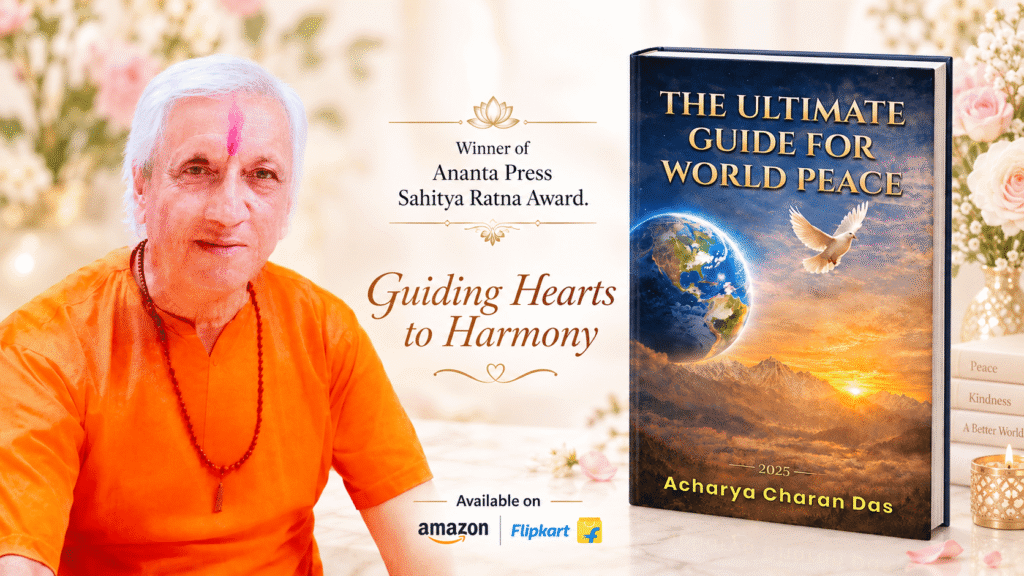
The physical and structural experience of reading The Ultimate Guide for World Peace is unlike that of a typical spiritual self-help book. Acharya Charandas has assembled a work that is expansive, illustrated, argumentative, documentary, devotional, and frequently encyclopedic. It contains fifteen chapters, a substantial preface and introduction, numerous quotations, visual plates, historical references, scriptural passages, lists, questions, commentary, and excerpts that function almost like evidence pinned to a very large board. This unusual form is one of the book’s defining qualities. It feels less like a single essay and more like a decades-long archive organized around one consuming question: why does humanity remain unable to achieve peace despite religion, science, education, wealth, technology, and international institutions?
The table of contents gives the reader an early sense of the scale. The book moves from a “missing clue” to detailed religious comparisons, then to population, Vedic influence, duties and renunciation, historical episodes, missing pieces of a puzzle, explicit solutions, a summary, deep thoughts, things to remember, statements, and suggested readings. These chapter titles do not create a conventional academic progression. Instead, they announce a process of investigation. The author appears to be gathering fragments from many domains in order to show that they belong to a single pattern.
That pattern is the relationship between consciousness and consequence. Charandas repeatedly argues that the world’s crises are not separate. Violence, environmental damage, family breakdown, religious conflict, greed, and social instability are presented as different expressions of a deeper problem: ignorance about the self and the laws of nature. The book therefore proceeds by association. A scriptural passage may lead into an argument about diet; a discussion of diet may lead into ecology; ecology may lead into economics; economics may lead into desire and self-control; self-control may return the reader to the Bhagavad Gita. The method is circular rather than linear, but it is not random. The same central principles are revisited from multiple directions.
The visual material is particularly important to this effect. The early plates list a remarkable range of subjects, including the soul, consciousness, self-realization, historical religious events, animal treatment, environmental themes, Socrates, Galileo, spiritual teachers, and more. Some pages contain historical images or quotations; others use pictures of environmental destruction or animals to create emotional immediacy. The book clearly wants to engage both intellect and conscience. It is not satisfied with abstract argument when a photograph can make suffering visible.
This documentary style gives the work a raw quality. It does not feel over-sanitized. The reader senses an author collecting materials because he believes they matter urgently, even when the transitions are abrupt or the typography becomes emphatic. Capitalization, rhetorical questions, repeated phrases, direct addresses, and exclamatory passages all contribute to the sense of a speaker who is trying to wake the reader up rather than quietly guide a seminar. In literary terms, this is a distinctive voice: personal, insistent, devotional, and combative.
The book’s greatest formal strength is therefore abundance. Readers interested in the author’s worldview are given many entry points. A philosophically inclined reader may focus on the changing body and the enduring soul. A spiritually inclined reader may be drawn to self-realization, karma, devotion, and the Bhagavad Gita. A reader concerned with ecology may engage with arguments about natural resources, animal agriculture, and the treatment of sentient beings. A reader interested in comparative religion will find extended critiques of scriptural traditions and institutional history. A reader interested in ethics will encounter recurring discussions of example, duty, attachment, greed, anger, and moral responsibility.
Abundance, however, is also the book’s challenge. The manuscript is long, dense, and repetitive. Its historical and scientific claims vary in type and reliability, and not all are supported in the manner expected of contemporary scholarly nonfiction. The author frequently quotes or paraphrases material in support of a strong theological position. Readers who want to use the book as a source for factual claims should verify important details independently. This is especially necessary because the text includes controversial claims about religions, historical events, social groups, and scientific matters. Its value lies more securely in the coherence of its spiritual argument and the intensity of its moral inquiry than in treating every cited assertion as settled fact.
What makes the book readable despite its size is its use of recurring images and analogies. The world is compared to a machine that needs the correct manual. Human consciousness is compared to a field that must be cultivated. The mind can become a friend or an enemy. A person must distinguish genuine from artificial goods rather than trusting advertising. Peace is pictured as the result of correcting causes rather than hiding symptoms. These recurring metaphors help the reader navigate the large quantity of material.
Another important formal quality is the way the book speaks directly to the reader. It frequently asks questions rather than merely issuing conclusions. What is the missing link? What happens if humanity continues on the same path? Can a teaching be considered peaceful if its practical results produce suffering? Are technological advances meaningful if human beings remain anxious and violent? What is the difference between inherited belief and universal truth? These questions create an interrogative reading experience. The reader may disagree, but remaining passive is difficult.
The preface adds historical depth to the project. Charandas explains that he had prepared an earlier manuscript in response to the Turner Tomorrow Award around 1990, focused on the survival and prosperity of life on Earth. This background helps explain why the book feels accumulated rather than newly conceived. It has the texture of a project revisited, expanded, updated, and carried forward across decades. That long gestation contributes to its uniqueness. The Ultimate Guide for World Peace is not simply a commentary on the mood of 2026; it is presented as the continuation of a much older personal mission.
The closing portions of the book reinforce its compendium-like identity. Instead of ending immediately after a single conclusion, the work offers summary material, deeper thoughts, things to remember, statements, and suggested readings. It behaves almost like a handbook the reader is expected to revisit. This is consistent with the title’s use of the word “guide.” Whether a reader accepts its guidance fully or selectively, the book is designed for repeated consultation rather than one-time consumption.
As a work of spiritual nonfiction, The Ultimate Guide for World Peace is remarkable for scale, texture, and determination. It combines sermon, archive, comparative argument, environmental warning, ethical reflection, devotional writing, and illustrated commentary. That combination is not always smooth, but smoothness is not the book’s primary aim. Its aim is to assemble enough material to persuade the reader that the crisis of peace is comprehensive and therefore demands a comprehensive response.
For readers who appreciate unconventional books built from many kinds of material, this work offers a distinctive experience. It is best approached slowly, with room for reflection and independent checking. Its uniqueness lies not only in what it argues but in how it gathers the world into a single moral frame. Charandas wants the reader to see connections where modern life tends to create compartments. The result is a sprawling, passionate, and unmistakably individual book that turns the search for world peace into an investigation of nearly every major domain of human conduct.Amazon Link: https://www.amazon.in/ULTIMATE-GUIDE-WORLD-PEACE-ebook/dp/B0H27JGP8W/