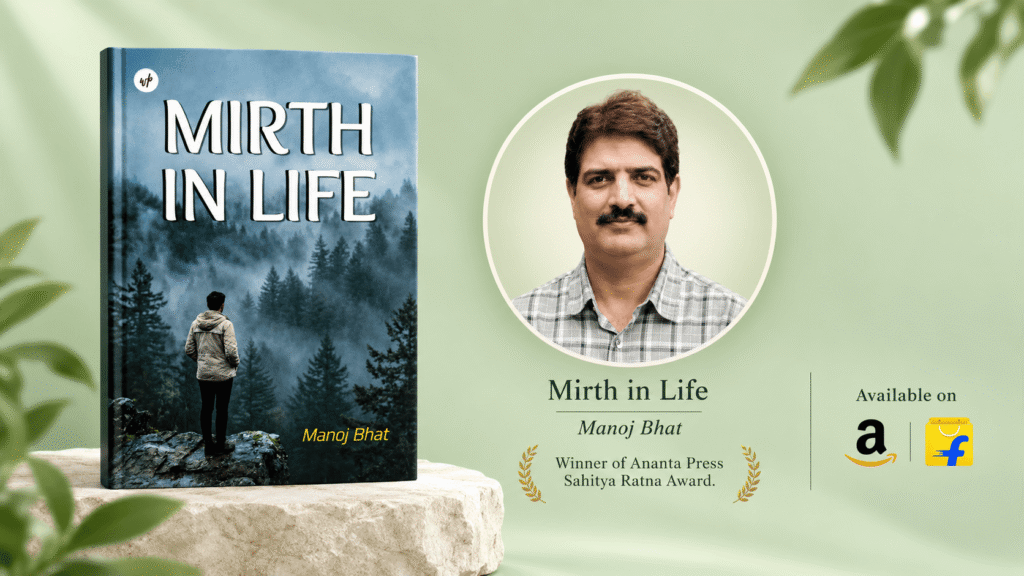
There is a particular kind of restlessness that belongs to modern life: the feeling of having achieved something and yet not feeling complete. Manoj Bhat’s Mirth in Life builds its story around that paradox. Through Rohan and his friends Gurdeep, Akriti, Irfan, and Tapas, the novel examines the tension between measurable progress and emotional fulfillment. The result is a work of general fiction that speaks directly to readers living in a culture of targets, timelines, plans, and constant comparison.
Rohan is an effective figure through whom to explore this subject because he begins with advantages that are usually associated with success. He is intelligent, capable of foresight, and eager to make a meaningful impact. He is not drifting without purpose. He and his friends develop plans and objectives, and they attempt to move beyond negativity and skepticism. In many books, that would be the formula for triumph. In Mirth in Life, however, it becomes the starting point for a more difficult question: what happens when the formula works externally but fails internally?
The novel’s answer unfolds through the mismatch between financial freedom and emotional freedom. Rohan achieves the former relatively early, yet amusement, cheerfulness, and glee remain clouded. This idea gives the book contemporary resonance. Professional accomplishment can provide stability and confidence, but it can also create the expectation that one should now feel happy. When the expected emotion does not arrive, the confusion can be profound. Bhat gives narrative form to that confusion.
The title is therefore more layered than it first appears. “Mirth” is not treated as simple entertainment or momentary pleasure. It becomes a symbol for a life experienced with lightness, gratitude, and inner equilibrium. Rohan’s search suggests that genuine mirth may require a reorganization of values rather than another external milestone. The novel is ultimately concerned with the architecture of a good life.
This is where the friendship group becomes important. Gurdeep, Akriti, Irfan, and Tapas are not merely supporting names around the protagonist. Their presence turns the story into a collective experiment. People often discover their values through relationships because friendship reveals both the limits and possibilities of the self. A friend can challenge a belief, offer perspective, share a burden, or simply remain present when no solution is available. In a book concerned with isolation, regret, and melancholy, companionship becomes one of the most meaningful forms of resistance.
Mirth in Life also benefits from its awareness of uncertainty. Rohan and his friends begin with carefully defined objectives, but the story emphasizes that the unplanned period eventually becomes the most interesting. This insight is psychologically convincing. Plans are built from what we already know, while unexpected events force us into contact with what we do not know about ourselves. The characters’ encounters with the unforeseen become opportunities for transformation.
The imagery of time reinforces this theme. The clock is always moving. Opportunities change. Destiny takes surprising turns. Rohan wonders in which direction the wind is moving and how circumstances can fall apart. These observations create a sense that life is both precious and unstable. They also challenge the temptation to postpone happiness until all conditions are ideal. If time is constantly moving, then the ability to live meaningfully in the present becomes as important as the ability to prepare for the future.
The reference to Robert Frost’s “The Road Not Taken” gives literary shape to the novel’s fascination with choice. Every life contains roads not taken, and with them comes speculation about what might have happened otherwise. That speculative space can create regret, but it can also create self-awareness. Rohan’s journey recognizes that choices form identity. The path one selects does not merely determine events; it changes the person who is doing the choosing.
The book’s engagement with scriptures and meaningful messages broadens its inquiry beyond psychology. It suggests that the problem of happiness has been considered across generations and traditions. Rohan and his friends are not the first people to discover that possessions and intellect can coexist with dissatisfaction. By turning toward spiritual and philosophical sources, the novel connects personal struggle with a longer human conversation about peace, purpose, and acceptance.
This gives Mirth in Life a contemplative quality. Readers looking only for fast external action may find the book more inward than expected, but those who enjoy fiction that creates room for thought will appreciate the approach. The narrative is interested in the consequences of events, but even more in the meanings assigned to those events. A setback matters because of what it forces the characters to reconsider. A success matters because of what it fails to provide. The novel’s real drama is interpretive.
Manoj Bhat’s own life experience makes the theme particularly credible. His education in English Literature provides an obvious foundation for the book’s literary sensitivity, while his professional history spans corporate achievement and decades of government service. He knows, at least biographically, the worlds of targets, recognition, responsibility, and long-term commitment. That background gives additional context to a novel asking whether achievement can satisfy every dimension of a human life.
One of the most valuable aspects of the book is its challenge to simplistic positivity. Rohan and his friends do try to reject negativity, but the narrative does not suggest that suffering disappears because one decides to think positively. Instead, hardship must be confronted, interpreted, and integrated. Regret and misery are treated as genuine forces. The search for happiness therefore requires more than cheerful language; it demands resilience and perhaps a deeper philosophy.
This is why the book may connect strongly with readers in midlife or anyone who has already achieved some of the goals once imagined to be decisive. There often comes a point when success changes from a destination into a question. What now? Why does this not feel the way I expected? What should define the next stage? Mirth in Life gives those questions a fictional environment in which they can be explored without reducing them to advice.
The novel’s uniqueness lies in this fusion of story, reflection, friendship, and spiritual inquiry. It is neither purely philosophical nor purely plot-driven. Its characters pursue a practical life while simultaneously questioning the assumptions that structure that life. The effect is a book that can encourage self-recognition. Readers may see elements of their own plans, anxieties, or postponed hopes in Rohan’s experience.
Ultimately, Mirth in Life argues through its narrative that living well is a skill different from achieving well. Intelligence can help us understand problems, money can reduce certain pressures, and ambition can create movement. Yet peace requires another kind of work: learning what deserves attention, how to respond to uncertainty, where relationships fit within our ambitions, and what kind of inner orientation can survive changing circumstances.
Manoj Bhat has chosen a subject with enduring relevance. Human beings have always wanted happiness, but contemporary life gives the pursuit new forms and new measurements. Mirth in Life resists those measurements long enough to ask a more fundamental question: when the targets are met and the plans completed, what remains? In the space opened by that question, the novel finds its purpose. It is a reflective, humane work about the difficult but necessary search for joy that is not dependent on external success alone.
Amazon Purchase Link: https://amzn.in/d/0aKhgiLE