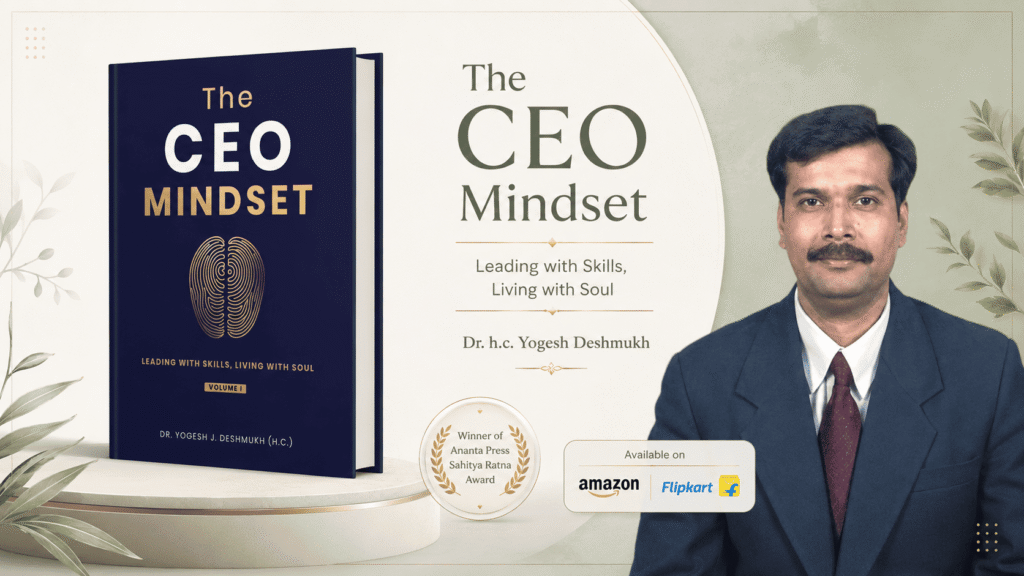
Many leadership books are organised around the question, “How do I win?” The CEO Mindset: Leading with Skills, Living with Soul, Volume I is built around a more enduring question: “What kind of leader am I becoming while I pursue success?” That change of emphasis gives Dr. h.c. Yogesh Deshmukh’s book its reflective power. Rather than reducing leadership to techniques for influence, growth, or competitive advantage, he examines the relationship between external achievement and internal alignment. The book’s central proposition is that leadership becomes truly sustainable when strategy, skill, values, purpose, and humanity reinforce one another.
This is why the author’s phrase “sustainable significance” deserves attention. The business world is exceptionally good at measuring success. Revenue, margin, schedule, valuation, productivity, market share, and growth can all be tracked. Significance is harder to quantify. It asks whether the work was worth doing, whether the institution became stronger in meaningful ways, whether people were treated responsibly, whether trust survived pressure, and whether the leader’s influence created value beyond personal status. By introducing this broader frame, Deshmukh does not dismiss metrics; he places them within a larger moral and organisational context.
The book’s title is equally deliberate. A CEO mindset is not presented as the psychological property of a person with a particular designation. It is a way of approaching responsibility. The mindset includes strategic awareness and execution, certainly, but it also includes courage, humility, empathy, self-examination, integrity, and continuous learning. This makes the book useful not only for chief executives but for anyone whose decisions affect people and systems. Senior managers, entrepreneurs, project leaders, professionals preparing for broader responsibility, and even experienced specialists can find relevance in its core argument.
Deshmukh is well positioned to write about responsibility because his professional life has unfolded in environments where consequences are tangible. His more than thirty years of work across railway signalling, high-speed rail, metro systems, software engineering, renewable energy, and infrastructure expose him to the realities of multidisciplinary execution. In such settings, leadership cannot be separated from accountability. A missed interface, weak communication, or poorly understood risk may affect schedules, safety, cost, or public outcomes. The author’s insistence on integrity and attentive leadership therefore arises from more than philosophical preference. It reflects the demands of serious work.
What makes the book distinctive is the way it combines this engineering seriousness with introspection. The analytical and the emotional are repeatedly held together. So are systems and soul, engineer and empath, strategy and humanity. This paired language communicates a central insight: leadership fails when it over-identifies with one half of a necessary whole. A purely analytical leader may understand data but miss morale, fear, resistance, or ethical discomfort. A purely relational leader may understand feelings but fail to establish clarity and standards. The mature executive must integrate both.
The book also challenges the idea that power should create distance. Traditional executive mythology often positions the CEO as someone above the ordinary pressures of work: the decisive figure who sees the whole board while others manage details. Deshmukh reverses that image. Leaders are among people, not beyond them. They are affected by pressure and uncertainty, and their humanity is not a defect to conceal. What matters is whether they develop the inner discipline to respond intentionally. In this sense, self-leadership becomes a prerequisite for organisational leadership.
That idea is especially important when authority grows. A junior professional may have a bad day and affect a few colleagues. A senior executive’s mood, ego, or blind spot can influence an entire function or organisation. The higher the role, the more important emotional regulation and self-awareness become. The CEO Mindset encourages readers to think about leadership presence: the quality of attention brought into a room, the signals sent through tone and behaviour, and the way leaders react when events challenge their preferred narrative.
The book’s treatment of listening is a good example. Listening is sometimes described as a communication skill, but here it can be understood as a form of governance. Leaders need access to reality. If people fear consequences for sharing difficult information, the executive’s picture of the organisation becomes distorted. Listening therefore protects decision quality. It keeps the leader connected to the lived experience of teams and allows dissenting information to enter before problems become crises. Humility, in this framework, is not ornamental virtue; it is a mechanism for staying informed.
Purpose is another important dimension. Organisations frequently publish mission statements, but purpose becomes meaningful only when it shapes difficult choices. A leader who speaks about values when conditions are easy has not yet demonstrated much. The test comes when there is tension between short-term advantage and long-term trust, between appearance and truth, or between speed and responsible judgment. Deshmukh’s emphasis on ethical decision-making suggests that leadership identity is formed in those moments. Values become real when they cost something.
The author’s academic work gives additional context to these themes. As a DBA researcher at XLRI/IPAG Business School, he focuses on strategic coherence, governance, and project lifecycle management in mega infrastructure projects. He has also created the ORBIT framework—Operational Resilience, Business Integration and Transformation—as a Strategy-to-Delivery governance model intended to reduce strategic drift and strengthen executive decision-making in complex projects. The CEO Mindset is not described as a textbook on ORBIT, but the connection is intellectually revealing. Both the professional research and the leadership book are concerned with alignment: how to keep intention, decision, execution, and outcome from drifting apart.
At the personal level, the same problem exists. Leaders can experience a kind of internal strategic drift. They may begin a career with clear values and gradually become defined only by targets, deadlines, competition, and reputation. The book’s “living with soul” dimension can be read as a call to prevent that drift. It asks executives to maintain coherence between what they say matters and how they actually behave. Personal integrity, in this sense, is a form of alignment.
This reflective quality makes the book especially suitable for readers who have already consumed conventional management advice. Someone familiar with goal-setting, performance management, stakeholder engagement, and strategy may not need another collection of techniques. What they may need is a framework for questioning how those techniques are used. Are people being treated as partners or instruments? Does urgency justify poor behaviour? Does winning a negotiation weaken a long-term relationship? Is the organisation building capability or merely extracting effort? The CEO Mindset invites readers to consider these deeper layers.
The book also carries an important message about legacy. Senior leaders eventually leave their roles. What remains is not only the projects completed or numbers achieved but also the habits embedded in the organisation. Did people learn to hide problems or surface them? Did teams become dependent on one personality or capable of sound judgment? Did emerging leaders learn that authority means control or stewardship? Legacy is created long before a farewell speech. It is built through repeated leadership choices.
For this reason, the book’s appeal extends beyond immediate career advancement. It speaks to readers concerned with the long arc of professional life. Achievement matters, but it cannot answer every question about meaning. The most respected leaders are often remembered not simply for what they built, but for how they conducted themselves while building it. Deshmukh gives that “how” a central place.
The CEO Mindset stands out because it does not force readers to choose between performance and humanity. Instead, it argues that the strongest performance cultures are often those in which responsibility, trust, clarity, learning, and purpose coexist. The book is aspirational, but its aspiration is grounded in the author’s long exposure to complex work. It understands that leaders must make decisions, confront problems, deliver outcomes, and hold standards. Its contribution is to show that none of those obligations require a leader to abandon empathy or integrity.
Ultimately, this is a book about coherence—between skill and soul, authority and humility, strategy and values, ambition and responsibility. Its message is not that leadership should become softer. It is that leadership should become more complete. For readers who want to build organisations without losing sight of the human beings inside them, and who want professional success to lead toward significance rather than away from it, The CEO Mindset offers a thoughtful and timely perspective.
Purchase on Amazon: https://www.amazon.in/dp/9371399201