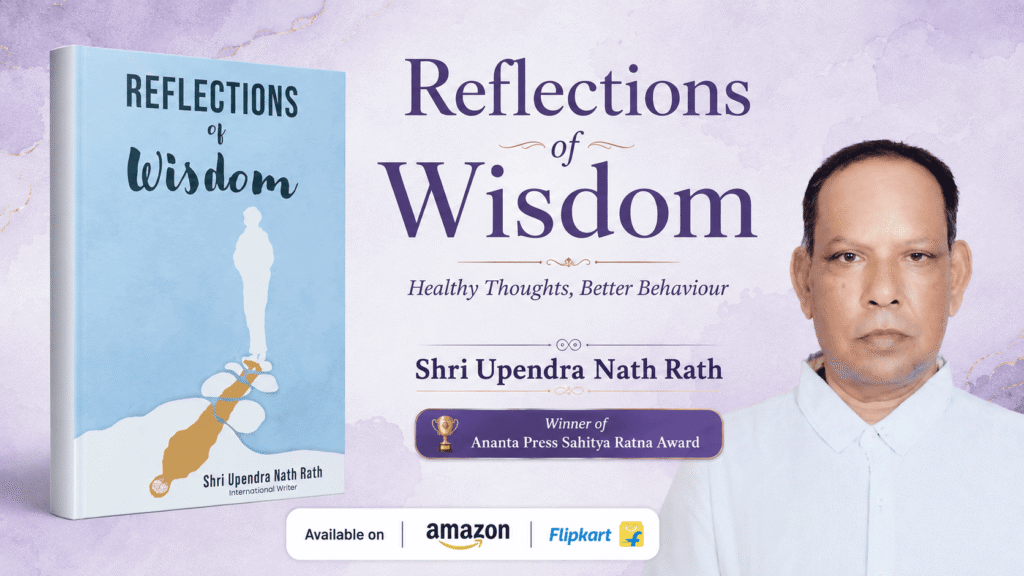
The central appeal of Reflections of Wisdom by Shri Upendra Nath Rath is that it does not separate the individual from society. Its stated themes—healthy lifestyle, manners, way of living, and social behavior—belong together because no person lives in isolation. Our routines affect our families, our speech affects relationships, our choices affect the environment, and our behavior contributes to the emotional climate of the communities around us. This book can therefore be read as a bridge between self-improvement and social responsibility.
Many books on personal growth begin with the individual and end with the individual. They ask how a reader can become happier, more successful, more productive, or more confident. Reflections of Wisdom occupies a more communal space. It recognizes that a better life is not only about private achievement. It is also about becoming the kind of person whose presence makes shared life healthier, more respectful, and more humane.
That distinction gives the book unusual relevance. Modern life often rewards competition and speed, but communities depend on cooperation and patience. Digital platforms reward visibility, but relationships depend on attention. Consumer culture encourages acquisition, but environmental health depends on restraint. Professional success can encourage self-focus, while society depends on service. A book that asks readers to reflect on how they live can help rebalance these competing pressures.
The healthy lifestyle theme is an important starting point. Health is personal, but its consequences are social. When individuals cultivate stable routines, emotional balance, cleanliness, discipline, and self-care, they are often better able to fulfill responsibilities toward others. Exhaustion, unmanaged stress, and unhealthy habits can influence communication and decision-making. Conversely, a balanced way of living can improve patience, reliability, and participation in family and community life. Reflections of Wisdom encourages readers to see health as part of responsible living rather than merely a private goal.
Manners provide the next link between self and society. Manners are small acts with cumulative effects. A respectful tone can prevent conflict. Listening can make another person feel valued. Gratitude can strengthen relationships. Punctuality communicates respect for other people’s time. Cleanliness in public places communicates concern for shared environments. Responsible use of resources acknowledges that others must also live with the consequences of our choices. These actions may not attract public recognition, but they form the texture of civilized life.
The author’s biography makes this connection especially compelling. Shri Upendra Nath Rath has spent much of his life in educational and community-oriented roles. Beyond a thirty-six-year career as an English teacher in Kendriya Vidyalaya, he has been active in Scouts and Guides, organized training programs, led plantation and cleanliness initiatives, supported poor students, helped disaster-affected families, and participated in welfare activities. His record suggests that he understands social responsibility as action, not merely as an idea.
His plantation work is particularly significant. He has conducted major plantation drives in educational and military-station communities, while his personal biography emphasizes a deep love for flora, fauna, birds, animals, and rural surroundings. This environmental commitment expands the meaning of “way of living.” A good way of living is not only about personal comfort or social courtesy; it is also about one’s relationship with the natural world. Environmental responsibility has become one of the defining ethical challenges of our time, and habits such as cleanliness, reduced plastic use, tree planting, and respect for living systems are direct expressions of social wisdom.
The author’s involvement in anti-polythene and cleanliness campaigns further supports this interpretation. Waste is both a lifestyle issue and a social issue. Individual convenience can create collective harm. Public cleanliness depends on private discipline. Environmental awareness therefore demonstrates the exact principle around which Reflections of Wisdom is organized: personal behavior and social outcomes are connected.
The same principle appears in the author’s educational service. Supporting free teaching for students from disadvantaged backgrounds is not simply charity. It is an investment in opportunity. Education can change a student’s confidence, employment prospects, family trajectory, and social participation. When a teacher voluntarily helps students improve academic performance, knowledge becomes a form of service. This background gives depth to a book that reflects on how one should live among others.
Assistance to fire victims and poor families reflects another dimension of social behavior: responsiveness. Communities become humane when people respond to one another’s difficulties rather than treating suffering as someone else’s problem. Modern societies are highly organized, but human need still frequently requires informal networks of care. A neighbor, teacher, volunteer, or local leader can make a difference precisely because they are close enough to act. Reflections of Wisdom is meaningful when read as an encouragement toward such everyday citizenship.
The author’s current role in community welfare also reinforces the continuity of this commitment. Even after a long formal teaching career, he remains involved in local leadership. That ongoing engagement suggests a philosophy in which retirement from employment does not mean retirement from responsibility. This is an important message for readers across age groups. Society benefits when experience is converted into mentorship, service, and local participation.
Another noteworthy aspect of the author’s life is his recognition for promoting world peace. Peace can sound like a distant ideal, but the themes of Reflections of Wisdom reveal its daily foundations. Peace begins in the ability to regulate one’s speech, respect differences, avoid unnecessary humiliation, resolve disagreements responsibly, and recognize the dignity of others. Social manners are therefore not merely decorative; they can be understood as micro-practices of peace.
The book is especially valuable in a time of increasing polarization. Public conversation often becomes aggressive, and disagreement is frequently treated as personal hostility. A reflective approach to social behavior can remind readers that strength does not require rudeness and conviction does not require contempt. Healthy societies need people who can communicate across differences. Manners become a form of social intelligence.
Reflections of Wisdom also offers an alternative to the idea that wisdom is something reserved for philosophers, scholars, or spiritual figures. The book’s thematic field suggests that wisdom is available in everyday choices. A person may demonstrate wisdom by eating and resting with discipline, caring for the environment, speaking respectfully, helping a vulnerable neighbor, supporting a student, or choosing service over indifference. This democratization of wisdom is one of the book’s most attractive qualities.
The author’s rural upbringing adds resonance to this outlook. Rural life often makes community interdependence more visible. People encounter nature directly, depend on shared systems, and recognize the importance of cooperation in ways that urban life can sometimes obscure. The author’s affection for village atmosphere appears consistent with his focus on social behavior and environmental responsibility. It provides a cultural memory of life as relationship rather than pure individualism.
For readers, the book can function as a self-audit. Instead of merely agreeing with positive values in principle, readers can ask practical questions. Are my daily routines supporting health? Do I speak to people respectfully when I am stressed? Do I make shared spaces cleaner or dirtier? Do I help others when I have the capacity? Do I behave differently toward people depending on their status? Do I use resources responsibly? Do my ambitions leave room for family, nature, community, and service? These questions transform reflection into ethical practice.
The book’s broad thematic scope also gives it intergenerational usefulness. Children and teenagers can learn the foundations of conduct. Young adults can apply them in college and early professional life. Parents can model them in the home. Professionals can bring them into workplaces. Senior citizens can use experience to mentor younger people. Because the concerns are universal, the book is not tied to a single stage of life.
Its uniqueness lies in integration. Healthy lifestyle books can become overly physical. Etiquette books can become overly formal. Social commentary can become overly abstract. Reflections of Wisdom brings these dimensions together under the larger question of how to live well. This integrated approach is more realistic because real life does not divide itself into neat categories. Health affects mood; mood affects communication; communication affects relationships; relationships affect communities; communities affect well-being. Everything is connected.
The author’s long history of teaching, Scouting, environmental work, and social service makes him a fitting voice for this integrated perspective. His life shows repeated movement from thought to participation. The book therefore carries an implicit challenge: wisdom should not remain on the page. Readers should translate reflection into habit, and habit into contribution.
For anyone interested in values-based nonfiction, community life, personal discipline, civic responsibility, environmental awareness, and humane conduct, Reflections of Wisdom offers a useful and timely perspective. It reminds us that the health of a society is not only determined by institutions. It is also determined by the ordinary behavior of millions of individuals.
In that sense, the book’s message is both modest and ambitious. It is modest because it begins with simple things: habits, manners, choices, relationships. It is ambitious because those simple things, multiplied across families and communities, can change the quality of collective life. Reflections of Wisdom encourages readers to understand personal improvement as a social contribution. A better society begins, in part, with a better way of living.Amazon / Purchase Link: https://share.google/vXOiJuSkHlGvVx2ny