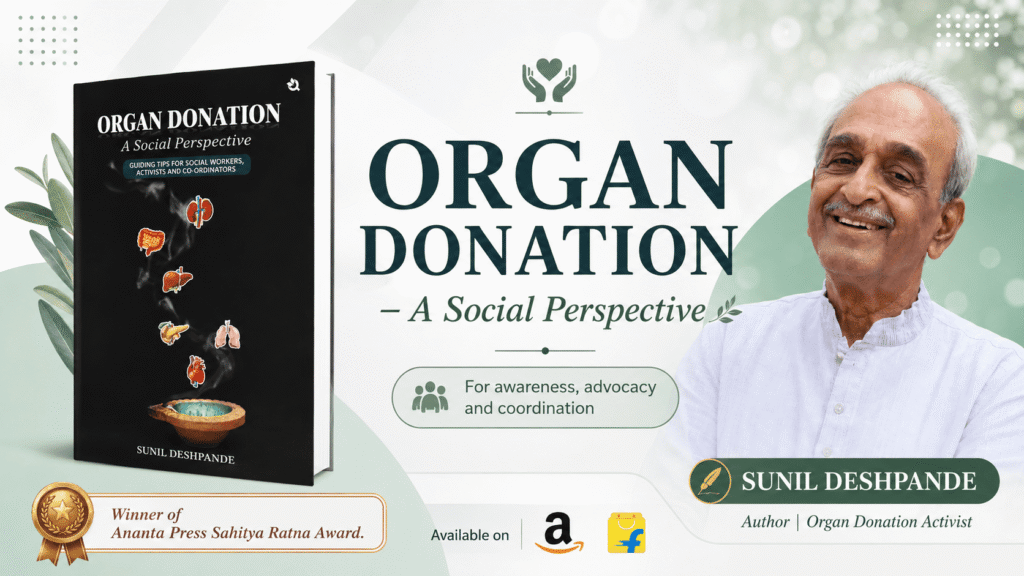
The value of a public-interest book can be measured in two ways. First, by the quality of the information it contains. Second, and sometimes more importantly, by whether it helps readers perform a useful role in society. Organ Donation – A Social Perspective by Sunil Ranganath Deshpande is best appreciated through this second measure. The book is aimed directly at social workers, activists, and coordinators, and its purpose is practical: to strengthen the people who explain organ donation to communities. In a country where medical progress and public awareness do not always advance at the same pace, that is a meaningful contribution.
Organ transplantation depends on sophisticated medicine, but donation begins outside the hospital. It begins when people understand what organ donation means, when families discuss the subject before a crisis, when myths are corrected, when trust is built, and when communities become familiar with the idea of giving life through donation. This makes awareness work essential. Yet awareness is often treated as if enthusiasm alone is enough. It is not. A person speaking publicly about organ donation needs knowledge, sensitivity, discipline, and an understanding of their social context. Deshpande’s book recognizes this need and provides a framework specifically for those communicators.
A major quality of the book is its clarity of audience. Many nonfiction books attempt to speak to everyone and therefore become too general. Organ Donation – A Social Perspective does the opposite. Its subtitle names the readers it wants to serve: social workers, activists and co-ordinators. This focus gives the book practical relevance. A social-work student preparing for a community campaign, a volunteer in an organ-donation NGO, a Rotary member organizing an awareness event, or a coordinator developing outreach material can approach the book with a clear question: how can I communicate this cause more responsibly and effectively?
The author’s background makes this focus credible. Sunil Ranganath Deshpande has spent years in organ-donation awareness and has worked through both voluntary organizations and formal committees. His leadership positions in the Mrutyunjay Organ Foundation and the Federation of Organ and Body Donation connect him with the voluntary sector. His membership of a government authorization committee for organ transplantation connects him with the official system. His Rotary experience places him within civic-service networks. This breadth matters because community awareness rarely succeeds in isolation. It requires cooperation between citizens, NGOs, medical professionals, administrators, and local leaders.
Deshpande’s four Avayavdaan Vaari padayatras are perhaps the clearest evidence of the experience behind the book. Approximately 4,000 kilometres of walking across Maharashtra between 2016 and 2020, accompanied by more than 500 awareness programs, represents an extraordinary amount of direct public interaction. The reported rural emphasis is particularly important. Rural communities are often underserved by specialized health information, and awareness methods developed for urban audiences may not translate easily. A campaigner who has spent so much time in rural settings is likely to understand that communication must adapt to local language, beliefs, levels of health literacy, and community dynamics.
This gives the book considerable training value. Social work education often teaches students to understand communities, identify stakeholders, build rapport, and communicate social messages. Organ donation is an ideal case in which all these skills must come together. A worker needs to know not only the message but also the audience. They need to anticipate misconceptions. They should understand the difference between awareness and coercion. They need to know when to refer a question to a medical professional. They must be prepared to speak about death with dignity while keeping the focus on informed choice. A field-oriented guide can help turn these general social-work principles into practical awareness practice.
The book is also significant because it frames organ donation as civic participation. Donation is often described as an individual act, but the social conditions around it are collective. Communities that discuss donation openly are more prepared than communities in which the subject remains taboo. Schools, colleges, service clubs, NGOs, local associations, religious organizations, and media platforms can all contribute to public understanding. By equipping social workers and activists, the book indirectly addresses this wider civic network.
Deshpande’s role in drafting a Marathi organ-donation pratidnya approved by the Government of Maharashtra illustrates the importance of culturally and linguistically appropriate communication. India cannot rely on one language or one communication style for a subject this sensitive. People are more likely to engage when information is expressed in words that feel familiar and respectful. The author’s work across Marathi, Hindi, and English, including books and a musical album on organ donation, reflects an awareness that a public message needs many forms if it is to reach diverse audiences.
Another quality that deserves attention is the book’s likely usefulness as a reference rather than a one-time read. A general reader may read a nonfiction book from beginning to end, appreciate it, and put it away. A guide for activists can be returned to repeatedly: before an event, while preparing a speech, when training new volunteers, or while planning an awareness drive. That repeat-use potential is one of the strongest indicators of practical value. The best handbooks become companions to action.
The book’s uniqueness is therefore functional. It stands out not because it is trying to compete with medical textbooks, but because it recognizes a missing layer in the organ-donation ecosystem. Doctors cannot personally conduct every community conversation. Government campaigns cannot answer every local doubt. Posters and slogans cannot replace dialogue. Social workers and activists are the people who often provide continuity. By focusing on them, Deshpande addresses the human network through which awareness actually spreads.
There is also an important lesson in the author’s long-term dedication. Awareness work can be frustrating because it is difficult to measure immediate results. A campaign may reach a thousand people, but the effect may emerge months or years later when a family remembers something they once heard. This makes persistence essential. Deshpande’s many years of lectures, rallies, books, and organizational service show a model of patient civic effort. The book gains credibility because it is not separated from that history.
From a reader-value perspective, Organ Donation – A Social Perspective can serve several groups. New activists can use it for orientation. Experienced workers can use it to reflect on their communication practices. Social-work educators can use it to discuss health awareness, public participation, and ethical campaigning. Civic organizations can use it when designing programs. General readers can use it to understand why organ donation is not only a hospital issue but a social one.
The ethical dimension is especially important. Organ donation touches people at vulnerable moments, so awareness work must be rooted in respect. A good campaign should create understanding without using fear or emotional pressure. It should encourage voluntary, informed decisions. It should respect family beliefs while providing accurate information. By emphasizing the social role of activists and coordinators, the book creates space for this ethical conversation. The best social workers know that how a message is delivered is as important as the message itself.
The broader importance of this book lies in its recognition that healthcare systems are strengthened by informed communities. Advanced transplant medicine cannot achieve its full potential if people remain unaware or mistrustful. Conversely, public enthusiasm without responsible systems can also be harmful. The bridge between these two worlds is education. Organ Donation – A Social Perspective is a contribution to that bridge.
For readers looking for a dramatic narrative, this may not be the book’s purpose. Its importance is quieter and more practical. It is a civic handbook built around a cause that requires both knowledge and compassion. It takes the experience of a veteran activist and directs it toward those who will continue the work. In that sense, the book is not merely about organ donation. It is about building a culture in which informed generosity becomes possible.