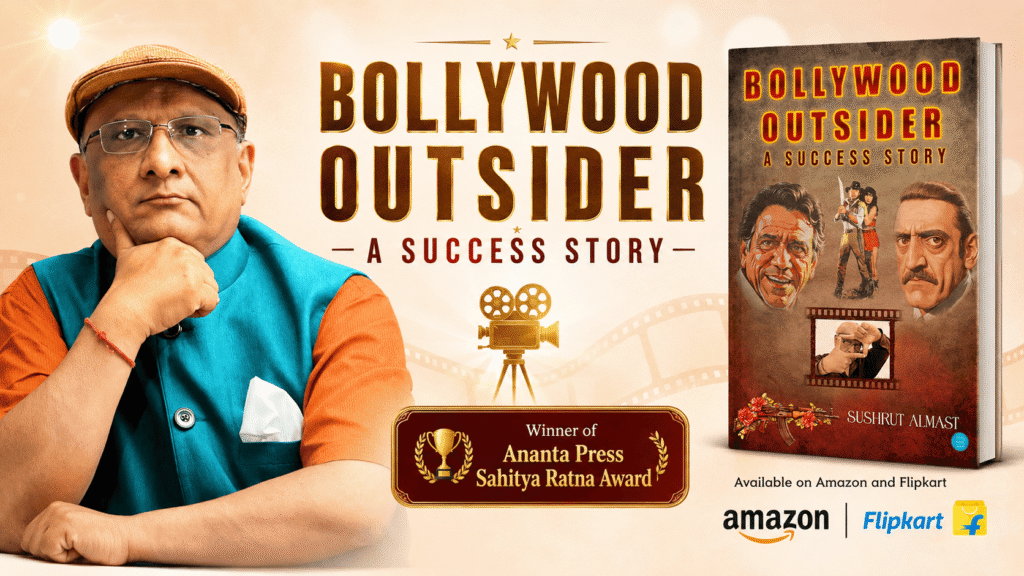
Bollywood Outsider – A Success Story occupies an interesting space between personal testimony, film-industry chronicle, and motivational literature. Its subject is the making and eventual success of Nirnayak – The Decider, a film that began life as Vyakul in 1991, was renamed in 1993, and reached theatres in 1997–98 after a difficult period of delay. Because the author, Dr Sushrut Almast, entered filmmaking from medicine rather than from an established cinema family, the book offers a perspective rarely available in glamorous accounts of Bollywood: the view from the edge of the system.
Popular writing about the Hindi film industry often concentrates on stars, celebrated directors, major studios, or iconic box-office events. Such stories are naturally attractive, but they can create the illusion that films emerge mainly from visible personalities and established institutions. Dr Almast’s narrative draws attention to another part of cinema history—the determined independent producer who assembles a project despite lacking inherited access. This perspective is valuable because the history of Indian film is not made only by those whose names dominate publicity. It is also made by people who take risks behind the scenes, sustain productions during uncertain years, and continue working when the industry offers no guarantee of recognition.
The period covered by the book adds to its importance. A film developed during the early 1990s belonged to a very different technological and commercial environment from the one filmmakers know today. Digital cameras, online casting networks, social-media promotion, direct-to-audience streaming, and inexpensive global distribution were not available in their present forms. A project’s survival depended heavily on physical production processes, personal negotiations, theatrical distribution, and industry relationships. For an outsider, these conditions could be especially unforgiving. The book’s journey therefore records not merely personal difficulty but the challenge of independent filmmaking in a pre-digital era.
The rebranding from Vyakul to Nirnayak – The Decider reflects the evolving identity of the film. “Vyakul” suggests restlessness, anxiety, or emotional disturbance, while “Nirnayak” suggests decision, judgement, and consequence. Even without a detailed scene-by-scene account, the shift in title evokes a movement from inner turmoil toward decisive action. It also mirrors the producer’s own experience. The project existed in a state of uncertainty before being carried toward release through a series of determined choices. In this way, the production history and the title reinforce one another.
A major point of interest is the pairing of Om Puri and Amrish Puri, described in the supplied synopsis as a unique “Clash of Titans.” Both actors brought extraordinary intensity to Indian cinema, though often through very different kinds of roles and screen energies. Their presence gives Nirnayak a place within a wider cultural memory. For cinema enthusiasts, the book offers the appeal of revisiting a film associated with two formidable performers. For aspiring producers, it demonstrates that an outsider-led project can still attract actors of major stature when the concept and leadership create sufficient confidence.
The film’s eventual theatrical success, as presented in the book description, gives the narrative its triumphant arc. Yet the story becomes even more fascinating through the film’s digital afterlife. The supplied details report more than sixteen million views on YouTube and a 7/10 rating on IMDb. These indicators show how the meaning of film preservation has changed. In the theatrical era, a film’s public life could seem limited by screens, territories, and release schedules. Online circulation allows a work to return, find new viewers, inspire comments, and become part of contemporary conversation long after its first commercial run.
This digital rediscovery turns Bollywood Outsider – A Success Story into a bridge between two periods of cinema. The film was created when access to production and distribution was highly concentrated, but it is now consumed through a platform that allows viewers across regions and generations to encounter it directly. The producer’s original struggle and the audience’s later accessibility form a striking contrast. What was once difficult to place before the public can now be replayed millions of times. The book therefore invites reflection on how technology can revise cultural memory and give older works a renewed life.
Dr Almast’s background makes his voice especially distinctive. A doctor trained in radiodiagnosis approaches the visible world through interpretation: an image must be examined carefully to understand what lies beneath it. That professional habit provides an intriguing metaphor for his account of Bollywood. The industry has a dazzling surface, but the outsider must learn to read the less visible structures beneath it—relationships, delays, risks, negotiations, and the emotional cost of persistence. Whether or not the book explicitly uses this medical analogy, the author’s analytical training likely contributes to his ability to observe a complex process from multiple angles.
His broader interests in finance, media arts, Vedic astrology, leadership, holistic health, and social organisations also prevent the narrative from becoming a narrow film memoir. He appears as a person committed to exploring systems of knowledge and applying them to practical life. His literary work, according to the supplied profile, focuses on inspiration, success, and happiness through real events. This orientation shapes the book’s tone. The film story is preserved not only because it concerns Bollywood but because it offers a lesson about human effort under pressure.
For cinema scholars and serious enthusiasts, the book’s value lies in its account of production from outside the dominant networks. Histories of popular cinema are strengthened when they include small and independent pathways, not only the best-known studios. A single project can reveal the working culture of an era: how long development could take, how uncertain release could become, and how much personal energy a producer might invest in keeping a film alive. Nirnayak’s journey from conception to theatre provides precisely this kind of microhistory.
For general readers, however, the book remains accessible because the emotional structure is universal. One does not need specialised knowledge of film production to understand the fear that a major effort may never reach completion. The author’s determination gives the narrative a clear human pulse. The reader can appreciate the film details while also recognising parallel experiences in publishing, business, education, public service, or personal reinvention. Every field has its insiders and outsiders, its unwritten rules, and its moments when persistence appears irrational until it finally produces a result.
The book is also a reminder that Bollywood is not a single story. It contains privilege and exclusion, glamour and administration, recognised names and invisible labour, immediate hits and delayed discoveries. By foregrounding the outsider producer, Dr Almast adds another voice to that complex landscape. His account does not ask readers to dismiss the importance of access; on the contrary, it makes the difficulty of lacking access very clear. Its optimism comes from showing that structural disadvantage, while real, does not always determine the final outcome.
Bollywood Outsider – A Success Story deserves attention from readers who enjoy cinema history with a personal heartbeat. It preserves the memory of a film, the effort of its producer, and the significance of a journey that crossed from the early 1990s into the digital present. The book’s uniqueness lies in this combination of eras and identities: a doctor becomes a producer, a shelved project reaches theatres, a theatrical film finds millions of online viewers, and an outsider’s struggle becomes a source of guidance for future creators. It is both a record of what happened and an argument for why stories from beyond the centre of the industry matter.